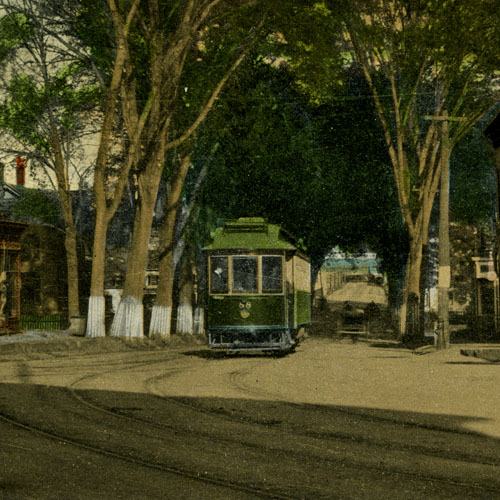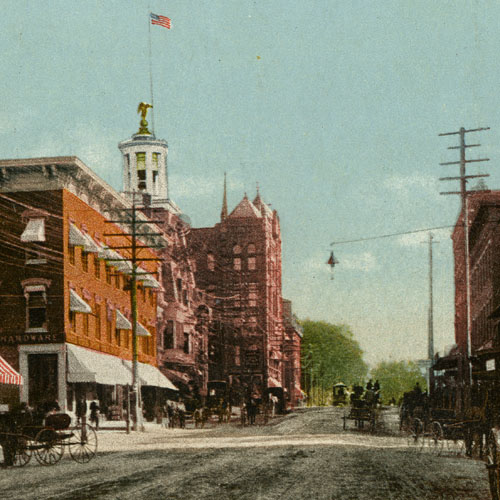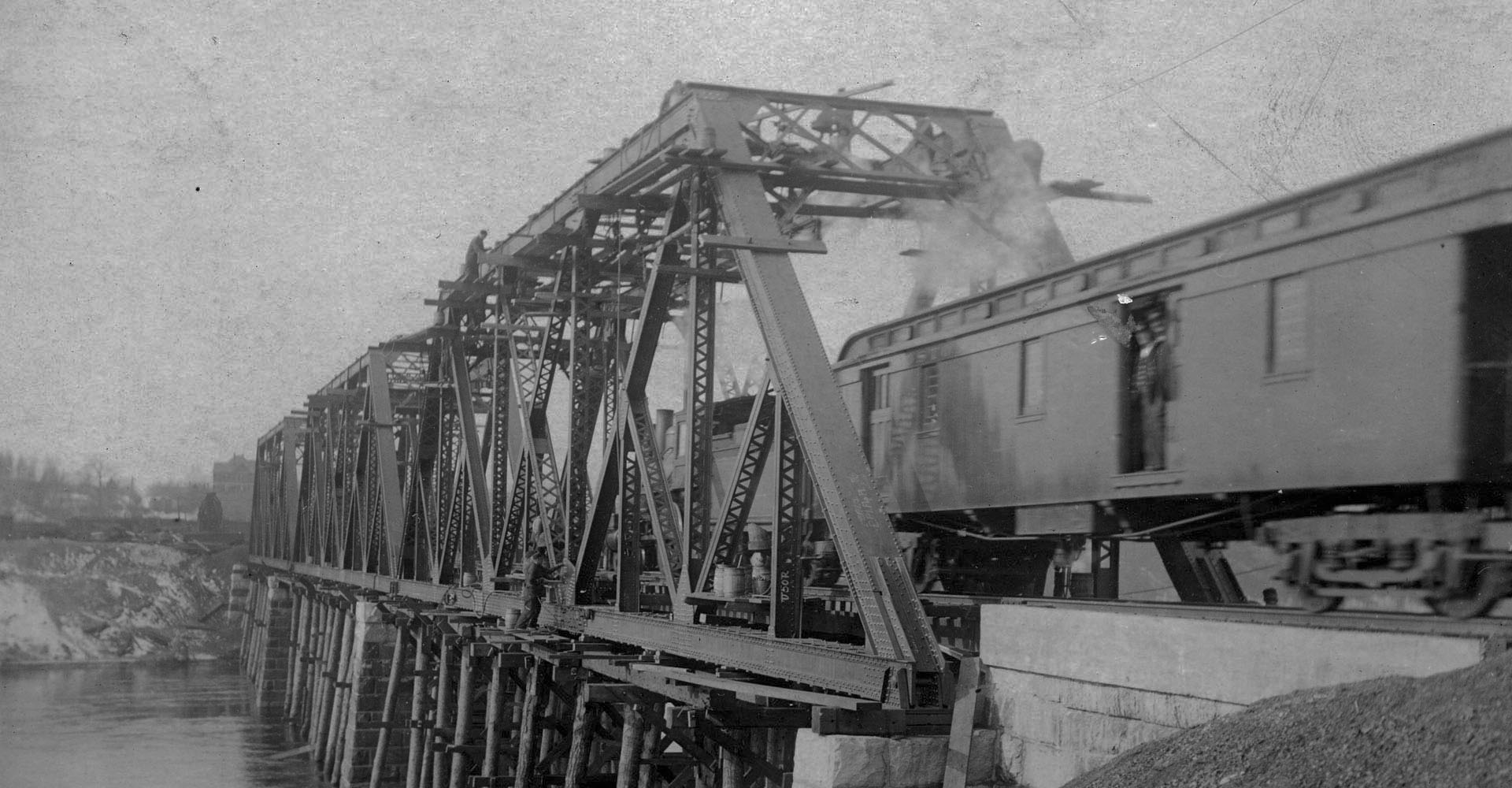
Manchester was an industrial center for New Hampshire, home to the Amoskeag Manufacturing Company and basically its growth and planning were dictacted by the company. Manchester was a junction for the Concord & Montreal and Boston & Maine Railroads, with the Concord & Montreal eventually being brought under the Boston & Maine, and was the target for many competitor railroads to try to pull some freight traffic from the mills onto their own rail lines. However the Concord & Montreal sucessfully kept the competitors at bay by building its own rail lines, creating pacts, or by pursuading state legislatures.
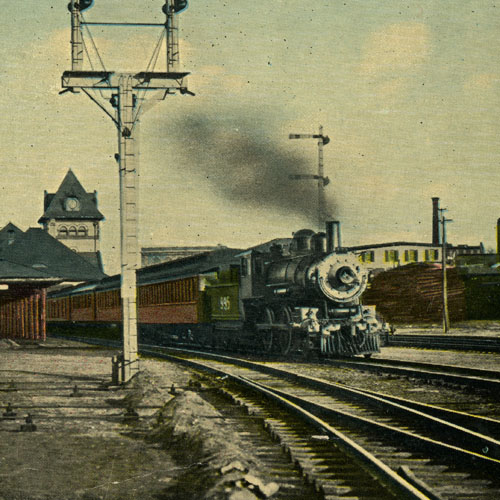
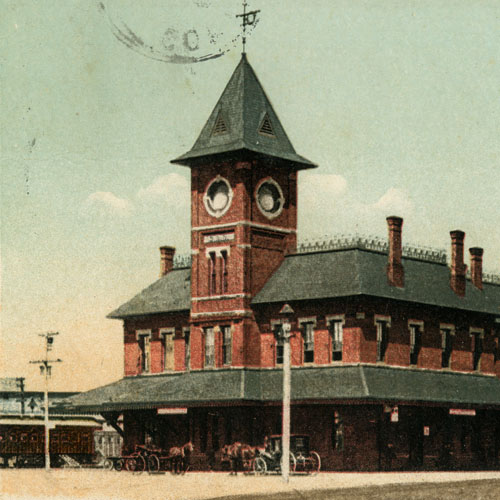
Manchester's original passenger station was built in 1855 and was located on the north side of Granite Street. At that time, Depot Street was located where the Center of New Hampshire now stands. The Boston & Maine Railroad took to constructing a new Union Station in Manchester, which opened in March of 1898 on the south side of Granite Street. The Manchester Street Railway later had a waiting room built at the end of one of the platforms in 1908. The two stations stood side by side for a short time before the old station was demolished, making way for the Amoskeag Manufacturing Company's company playground.
Depot Street was moved with the construction of the new station. The original street was renamed Traction Street because the Manchester Street Railway's carhouse, and Cedar Street was renamed west of Elm Street.
Sadly, Manchester's Union Station was torn down in the fall of 1962. At that time, Bradlee's department store was built on the old rail yard that was adjacent to the station in the corner of Auburn and Elm Streets. Another notable change in Manchester's landscape was the redevelopment of the Amoskeag mills. When the urban renewal hit the millyard, the canals were filled in creating Commercial Street and parking for the entire millyard. When the upper canal was filled in, the railroad tracks were shifted onto the edge of the canal bed and Canal Street was widened.
In 1980, when commuter rail came to New Hampshire, the site of Union Station was used for the simple dirt platform to handle commuters.

Manchester's Railroad Stations
The below list is of the railroad stations located within the city limits. A special thank you is due to Gary LaPointe of Railroad Stations of New Hampshire for his support of Nashua City Station's railroad station listings with the use of images from his website. Also, thanks goes to Joe Labbe for supplying a photo and information about the Goff's Falls depot.
Amoskeag
Located on the Concord Railroad, this station was designed by Bradford Lee Gilbert (also designed the Concord station) and built for the Concord & Montreal Railroad in 1892. This attractive station served the northern section of Manchester and is now a private residence at the end of Webster Street.
East Manchester
On the Portsmouth & Concord Railroad, the East Manchester depot was located Massabesic and Cypress Streets, and also served as the end of the East Manchester branch of the Manchester Street Railway. The station is gone and so are the tracks of the Portsmouth & Concord and Manchester Street Railway.
Goffs Falls
For which Depot Road is named, this building stood in two locations and served the railroad nearly 80 years. Originally constructed around 1856 by the Concord Railroad on the west bank of the Merrimack River in Bedford, it is reported to have been moved across the river, to the east bank in Manchester about 1868. This date is in question, and research indicates a date of 1898 is far more probable. In the village of Goff's Falls, it stood until about 1935.
Massabesic
Once a getaway for the residents of Manchester, this station stop was near the city limits and on the shore of Lake Massabesic. The railbed was abandoned in 1982 and now is part of the State of New Hampshire's rail-trail network.
West Manchester
This little station was located on the New Hampshire Central at the Main Street crossing. The roadbed has been converted to a rail-trail between Main Street and the east side of the Merrimack River, utilizing the old railroad bridge that spans the river.
Willey
This station was located on the Manchester & Lawrence Railroad near the southern edge of the Manchester airport.
|